
Two spray lines off solvent-borne PU in eleven weeks, zero batch rejections fourteen months later
Contract furniture manufacturer · Binh Duong · 2 spray lines
“Two furniture lines in Binh Duong moved off solvent-borne PU in eleven weeks. Fourteen months on: zero batch rejections and a VOC file that clears their European buyer's audit.”
Plant director · Contract furniture manufacturer · Binh Duong, Vietnam
Customer since 2024 · 2 spray lines · 3,400 drums delivered
- Switchover
- 11weeks
- Lines converted
- 2booths
- Batch rejections
- 0/ 26 lots
- Drums shipped
- 3,40020 kg
The starting point
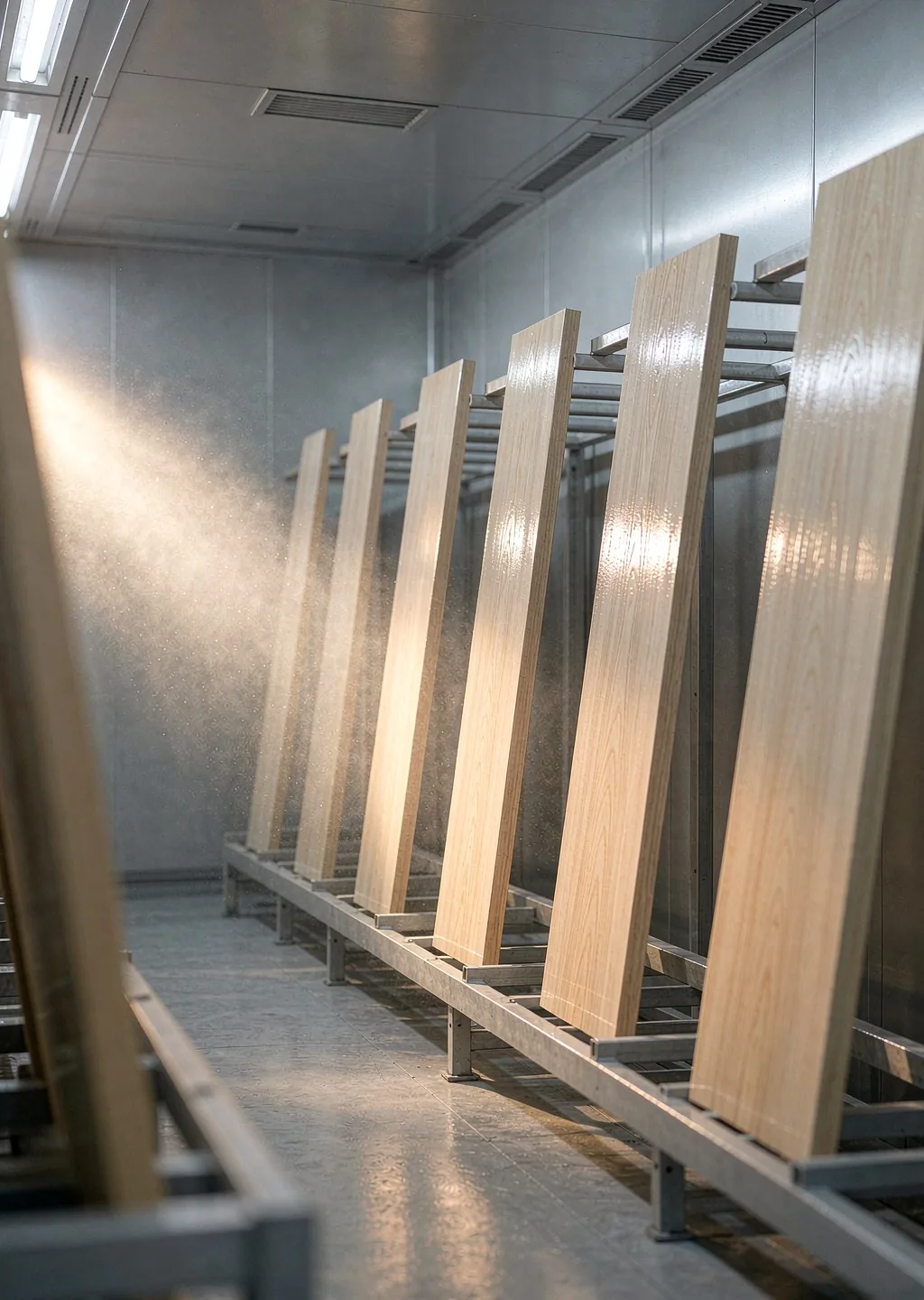
The plant finished contract furniture for a European buyer: oak and rubberwood frames, matte clear over a pigmented base, roughly 900 panels a shift across two spray booths. Both booths ran solvent-borne PU. The finish was never the problem. The paperwork was.
Their buyer had moved its purchasing spec to a formaldehyde and VOC threshold that the existing PU system could not document. Two audits in a row came back with the same finding: the coating file was incomplete, not the product.
What actually blocked the switch
Three things, in this order.
Sanding behaviour. The first waterborne sealer we trialled raised the grain hard on rubberwood end-grain. Sanding loaded the paper in under a minute and the line slowed to 60 percent of its rated output. We reformulated the sealer for a 30 °C / 85 % RH booth instead of a European lab.
Recoat window. Tropical humidity pushed the recoat window from two hours to a range that moved with the weather. The line needed a rule it could post on the wall, not a range it had to interpret. We published a booth-temperature table and a hard stop at four hours.
Drying before packing. Waterborne film that looks dry is not dry. Parts stacked at 90 minutes showed print marks after a container crossing. Packing now waits for a 24-hour floor, and the floor is written into the work instruction.
What we changed
- Sealer: 1K waterborne sanding sealer, reformulated for high-humidity booths.
- Topcoat: matte clear at 3–5 GU, same base across gloss levels 1–9.
- Gun cleaning: water rinse, no solvent wash, one less waste stream.
- Documentation: Vietnamese SDS, VOC test report, and a batch-to-batch COA pack the buyer could file directly.
Where it landed
Eleven weeks from the first trial panel to both booths running waterborne. Fourteen months on, 26 production lots and no batch rejections. The buyer audit that had failed twice passed on the documentation alone.
The number the plant cares about is not the VOC figure. It is the 3,400 drums that arrived without a single rework claim.
What we would do differently
We would run the packing-height test in week two instead of week seven. Print marks are the failure mode nobody budgets for, and they only appear after the container has been at sea for three weeks.